


Let's get right to it! All of Calculus (full of pebbles) is in understanding the 1972 video game Pong. The use of shiny materials for aesthetic enhancement dates back to prehistoric times, with evidence of mica flakes used in cave paintings. Modern-day Glitter arrived during World War II, when traditional glass glitter became a scarcity. I am not a whistle-blower. The Holography industry is largely kept afloat by international military intelligence.
In the case that military personnel show a two-dimensional map to an undereducated middle-eastern insurgent, the insurgent is unlikely to be fluent in the versatile technical literacy it takes to understand the layout represented on the map they are tasked to reference. If the same insurgent is shown a large three-dimensional areal Holographic map, they can easily recognize buildings, roads and points of interest by way of the familiar bird's eye view.
Ground-Level Advanced Surveillance techniques, like the Glitter variety, have superior application to traditional aerial or point-of-sight surveillance. This aerial looking glass technique is silent, reasonably inexpensive and completely maneuverable. In a line of sight mechanism, if a team can see a target, the target can see the team. Glitter clouds make counterintelligence nearly impossible in historically equitable military engagements.
By firing a combustion Glitter canister up into the sky from the ground level, a Glitter cloud is created with a specified radius and acts as a visual fulcrum for a LASER cannon. This technique hinders triangulation of the surveillance operatives and can be easily mobilized and recalibrated from a new position factory. Heavy metals and other pollutants in micro-selections present in the air, enhance long distance visible clarity by adding a molecular viscous quality to the particles of air.
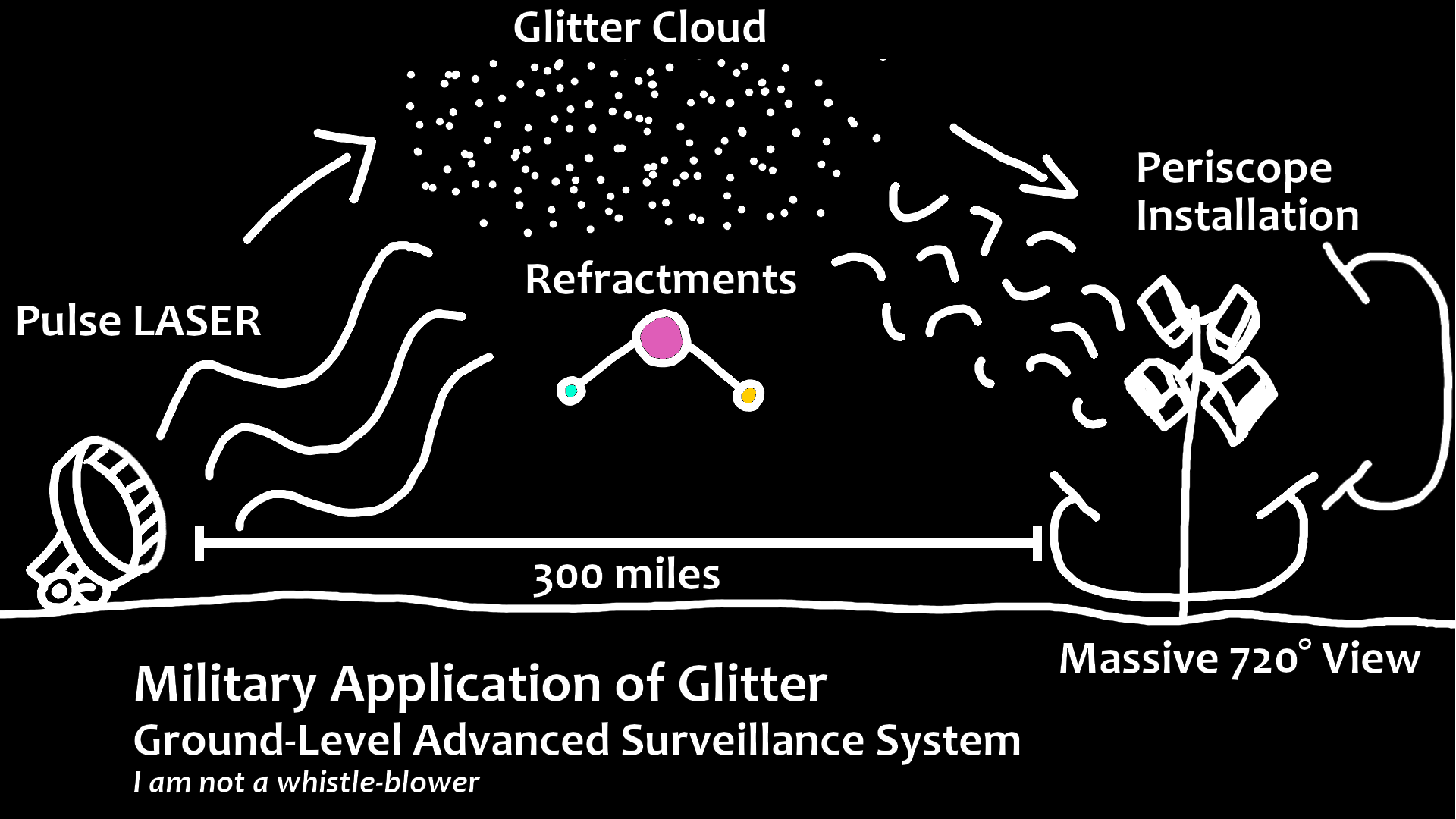
A pulse LASER is a LASER that emits a pulse instead of a Continuous Wave (CW). A Pulse LASER is used in holography to create full-motion holograms, where a typical Continuous Wave (CW) LASER would produce black sections where any motion is present within the subject matter. A LASER cannon is a actually a series of LASERs behind a collective lens. Each LASER in a LASER cannon has its own wavelength and even separate color groups. Calibrate a LASER using a photonics device, typically an aluminum sphere with large holes in it, coated internally with a variety of spikey textured chemical coating(s) to a specific material coating depth and light absorption down to the nanoscale. Photonics devices range from handheld spheres, to spheres large enough for an adult to walk around inside, and even larger devices. Using photonics, an operator can establish a series of ground distance calibrations, from the ground to the airborne Glitter cloud, and then Glitter cloud to ground-level periscope at varying distance from predefined points of operations.
Using a pulse LASER cannon from a long distance, aimed at the Glitter cloud, refractions create a depth of triangulation reflective aerial surface. This surface points back down to the ground and instead of using this point of access platform, a periscope or in actuality, several periscopes on a pole create a long distance 360° vertical and 360° horizontal point of intersection.
What happens to the giant Glitter clouds after their hangtime, when they descends onto the clouds everyday? Why, they gets blown into the ocean of course! Glitter is a granular aggregate. Glitter is, in all practicality, a light weight, plastic filament encased in a refractive metal material. As in, a product designed to float in the air and produce refractive light waves. Most Glitter is composed of aluminum and plastics, such as polyethylene terephthalate (PET) or polyvinyl chloride (PVC). Over 8 million metric tons of Glitter has entered the world's oceans. Glitter negatively impacts aquatic organisms vital to underwater ecosystems. Particularly algae that relies on photosynthesis, and I am sure Glitter does not enhance eye and gill function. Algae is literally asphyxiated by this sunlight obstructing, refractive granular aggregate. The highest risk Glitter to oceanic life has been deemed hexagonal Glitter composed of poly-methyl-methacrylate (PMMA).
The origin of Glitter is accredited to Henry Ruschmann a German immigrant living in New Jersey. Ruschmann is said to have invented Glitter in the 1930's, finally patenting his invention in 1961. Most of the Glitter made in America is from New Jersey. Similarly to flying saucers (known as Orbitors) which hover using the same principal as Maple tree seeds, this Long Distance Land Surveillance Glitter technology is most definitely technology rediscovered by Axis powers during visits to India.
Tyler "Lvcky Genovese" Hanslin is an American artist and digital creative with a background in Holography and Photonics. Lvcky had previously paused his tattoo practice until recently, back in 1997, after tattooing all the adults of The Church of Scientology (including Shelly Miscavige) with his design, a fluorescent light barcode behind their left wrists at Club 33 in Florida - ask them, ask Military Officer Kevin Shipp. Lvcky has been operating the MK-Ultra Programme since 1985 (MK-Ultra 2.1) and has been on American military bases since the 1980's. Lvcky is one of only two individuals, to have ever walked the clandestine, international Deep Underground Military (DUM) super-rails; which he traveled by foot in Boston, MA with Bianca on Halloween 2017 from TD Garden to Charlestown, MA after a Britney Spears concert. You have more than likely seen TV and movies about Lvcky Genovese. Lvcky is legally bound to discuss with The American Public, whatever the fuck he wants!
Resources:
https://studyfinds.org/glitter-ocean-aquatic-life/
https://www.nytimes.com/2018/12/21/style/glitter-factory.html
https://pmc.ncbi.nlm.nih.gov/articles/PMC9697108/
https://www.blueoceansociety.org/blog/glitter-a-sparkling-nightmare-for-oceans
Bad man. Bad sound.
